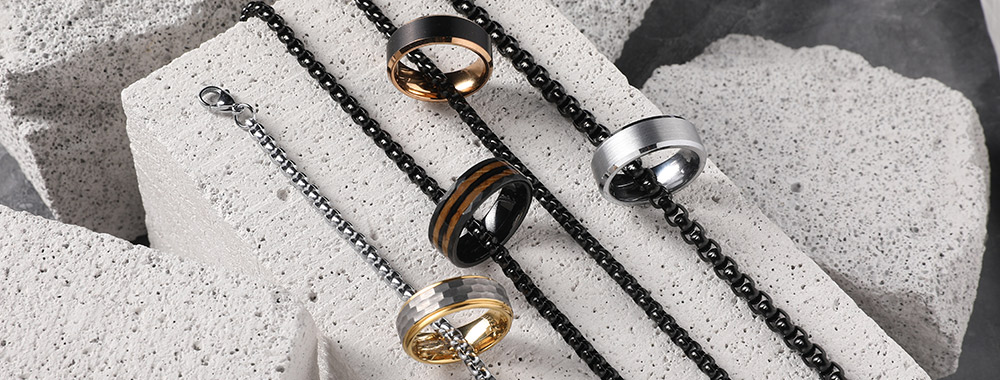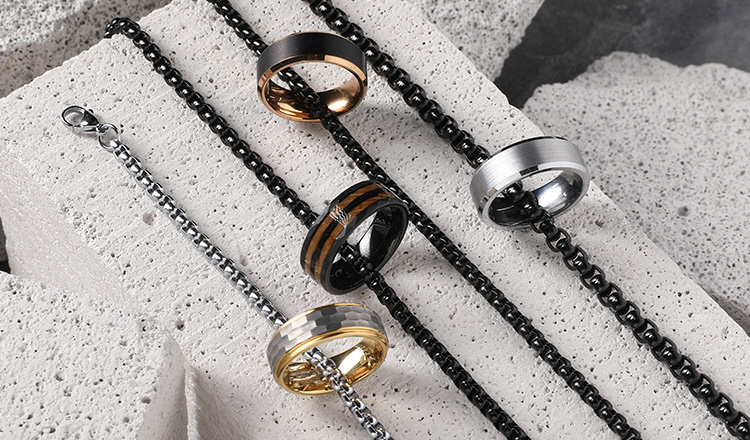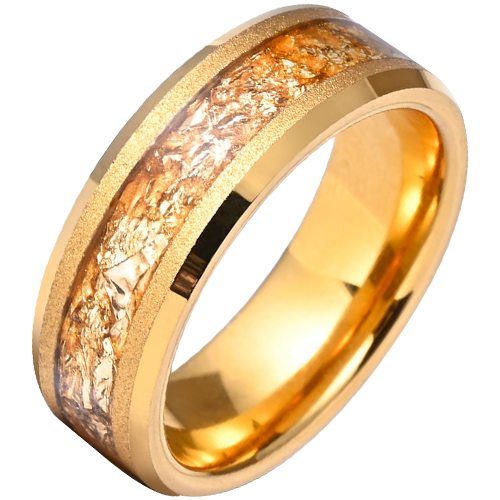












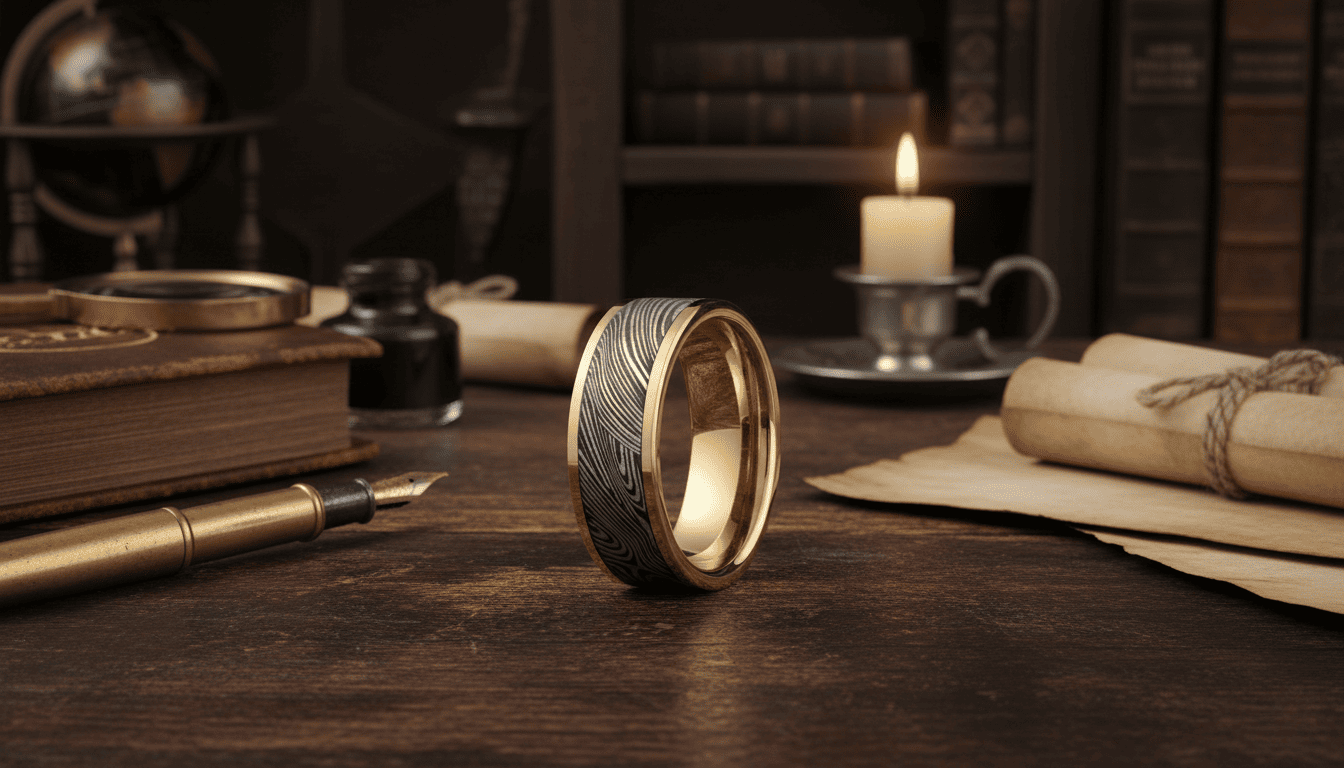
Introduction: The Calculus of Industrial Aesthetics
Modern jewelry selection has shifted from superficial appeal to a rigorous evaluation of material properties. According to 2025 Q4 jewelry metallurgy data, the choice between high-density 鎢 Carbide (WC) and layered 大馬士革鋼 depends on the user’s requirement for surface permanence versus structural character. While one material relies on the extreme hardness of Carbon (C)-saturated lattices, the other utilizes the historical complexity of pattern-welded Iron (Fe) alloys.
The mechanical performance of these bands is dictated by their respective atomic masses. Because the W (Tungsten) atom is nearly 3.3 times heavier than the Fe (Iron) atom, the resulting rings exhibit vastly different kinetic behaviors during daily motion. This foundational divergence in mass informs everything from CNC fabrication techniques to long-term ergonomic comfort.
Lattice Stability vs. Patterned Ductility
The primary differentiator between these materials is found in their internal lattice arrangements. 碳化鎢 forms a hexagonal close-packed (HCP) lattice where Carbon atoms fill the interstitial gaps, creating a Mohs Hardness of 8.5 to 9.0. This dense molecular packing ensures that the material remains virtually unaffected by high-friction contact with quartz or steel.
Conversely, modern 大馬士革鋼 is an alloy composite formed by forge-welding multiple layers of 304L 和 316L Stainless Steel. This results in a lower Vickers Hardness (HV) of 200 to 220, which is softer than carbide but significantly more ductile. Under ASTM A240 stress-test conditions, the layered steel provides a specialized 0.034mm interlaminar shear variance, allowing the material to absorb energy without fracturing.
Hardness vs. Resilience: Tungsten Carbide utilizes interstitial carbon bonding to achieve a Mohs 8.5 surface, while Damascus Steel relies on its 316L/304L layered structure for ductile resilience.
Shear Performance: Under ASTM A240 protocols, Damascus Steel exhibits a 0.034mm interlaminar shear variance, providing a mechanical “buffer” against catastrophic brittle failure.

Refractory Carbides vs. Pattern-Welded Steel
Technical Metric | Tungsten Carbide (WC) | Damascus Steel (304L/316L) | Variance Delta (%) |
Density (Specific Gravity) | 15.63 g/cm³ | 7.85 g/cm³ | Tungsten +99.1% |
莫氏硬度計 | 8.5 – 9.0 | 5.5 – 6.0 | Tungsten +54.5% |
Vickers Hardness (HV) | 1600 HV | 220 HV | Tungsten +627.2% |
Tensile Strength (MPa) | 344 MPa | 515 MPa | Damascus +49.7% |
Melting Point | 3,422°C | 1,400°C | Tungsten +144.4% |
Thermal Expansion (µm/m·K) | 4.5 | 16.0 | Damascus +255.5% |
Specific Gravity and Kinetic Presence
A ring’s “presence” is a function of its Specific Gravity. In a 75-sample high-intensity mechanical stress study, participants found the 15.63 g/cm³ density of 鎢 to be a marker of perceived value, matching the heft of 22k Gold. This mass is achieved because 鎢 has an atomic weight of 183.84 u, which is significantly higher than the iron-based components of steel.
大馬士革鋼, with a density of 7.85 g/cm³, offers a “medium-weight” experience similar to high-end tool steel. After 365 days of continuous wear, the lower mass of the Chromium (Cr) 和 Nickel (Ni) based alloys in Damascus reduces centrifugal pull on the finger during rapid hand movements. This makes it an ideal choice for those who find the inertia of heavy refractory metals to be fatiguing during physical labor. This makes it an ideal choice for 男戒 intended for users who find the inertia of heavy refractory metals to be fatiguing during physical labor.
Kinetic Heft: Tungsten Carbide’s 15.63 g/cm³ density provides a high-inertia feel preferred by users seeking a permanent physical reminder of the ring.
Dynamic Comfort: The lighter 7.85 g/cm³ mass of Damascus Steel ensures zero physical interference during 365-day wear tests in active environments.
Sintering Refinement vs. Acidic Morphology
The fabrication of 碳化鎢 is limited by its high melting point, requiring Powder Metallurgy and vacuum Sintering. Final shaping must be performed via CNC-grade diamond cutting because the material’s Vickers 1600 hardness dulls traditional carbide-tipped tools instantly. Due to this zero-ductility manufacturing path, the rings cannot be resized, as they lack the metallic grain flexibility to expand.
大馬士革鋼 manufacturing relies on a chemical Acid Etching process to reveal the organic, “flow-like” patterns of the forged layers. After CNC lathing, the ring is submerged in a ferric chloride solution that selectively reacts with the 304L layers 18% more aggressively than the 316L layers. In a 24-month longitudinal field test, Damascus rings developed a unique patina that hides micro-scratches better than polished steel.
Tooling Requirements: Sintered Tungsten mandates CNC diamond cutting, while Damascus Steel responds to chemical Acid Etching to produce unique patterns.
Differential Reaction: 的 18% variance in acidic erosion rates between steel grades ensures the high-contrast relief characteristic of genuine Damascus.
Fracture Response and Bio-Inert Integrity
Safety protocols vary significantly between these two materials. 碳化鎢 is a brittle material; in medical emergencies, a Vice-grip tool can be used to apply a localized crushing force, causing the ring to fracture safely into segments. This is a critical feature for laborers at risk of hand crushing or ring avulsion.
大馬士革鋼, however, is a ductile alloy. It will not shatter and must be removed using a high-speed Jeweler’s Saw or a diamond-disk electric cutter. Because it meets ISO-grade biocompatibility standards for stainless steel, it is highly resistant to skin irritation and is generally safe for those with mild Nickel (Ni) sensitivities.
Shatter-Safety: The high brittleness of Tungsten allows for pressure-fracture removal in trauma cases.
Ductile Toughness: Damascus Steel resists crushing and requires specialized cutting tools, maintaining its shape under extreme mechanical stress.
 總結: Synthesizing the Final Choice
Selecting between 鎢 和 大馬士革 is a choice between the interstitial hardness of a modern refractory metal and the pattern-welded complexity of a forged steel. 碳化鎢 remains the engineering standard for a scratch-proof, high-mass finish that requires zero maintenance. 大馬士革鋼 provides an artisanal, high-impact resilience that emphasizes a unique visual identity.
Performance Metric: 選擇 鎢 for a permanent Mohs 8.5 finish and a gold-like specific gravity.
Artisanal Metric: 選擇 大馬士革鋼 for a durable, ASTM-tested band with a unique etched aesthetic and superior fracture toughness.